
Articles
&
Features





-
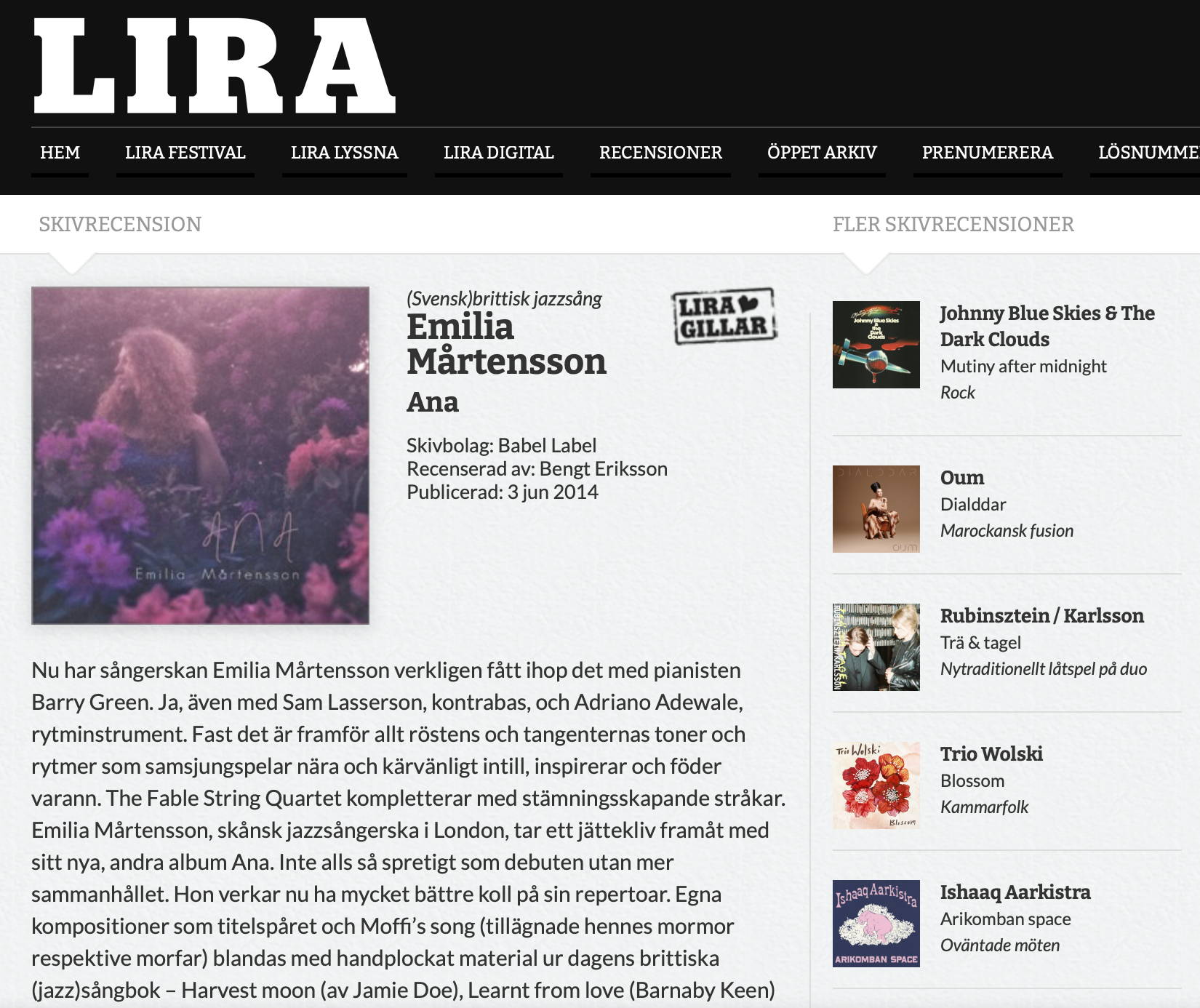
Critics have described Emilia Mårtensson's voice as ethereal, delicate and having "pearly innocence", all of which is true. But she has other qualities which save her from sounding bland or passive. She has a very sharp sense of time and the alertness to her fellow musicians that distinguishes jazz singers from the rest. Whether it's a Swedish folk song, one of her own pieces or a tune by jazz saxophonist Joe Henderson, this is what makes each of these 10 numbers fresh and immediate. Pianist Barry Green and bassist Sam Lasserson are outstanding too.
-
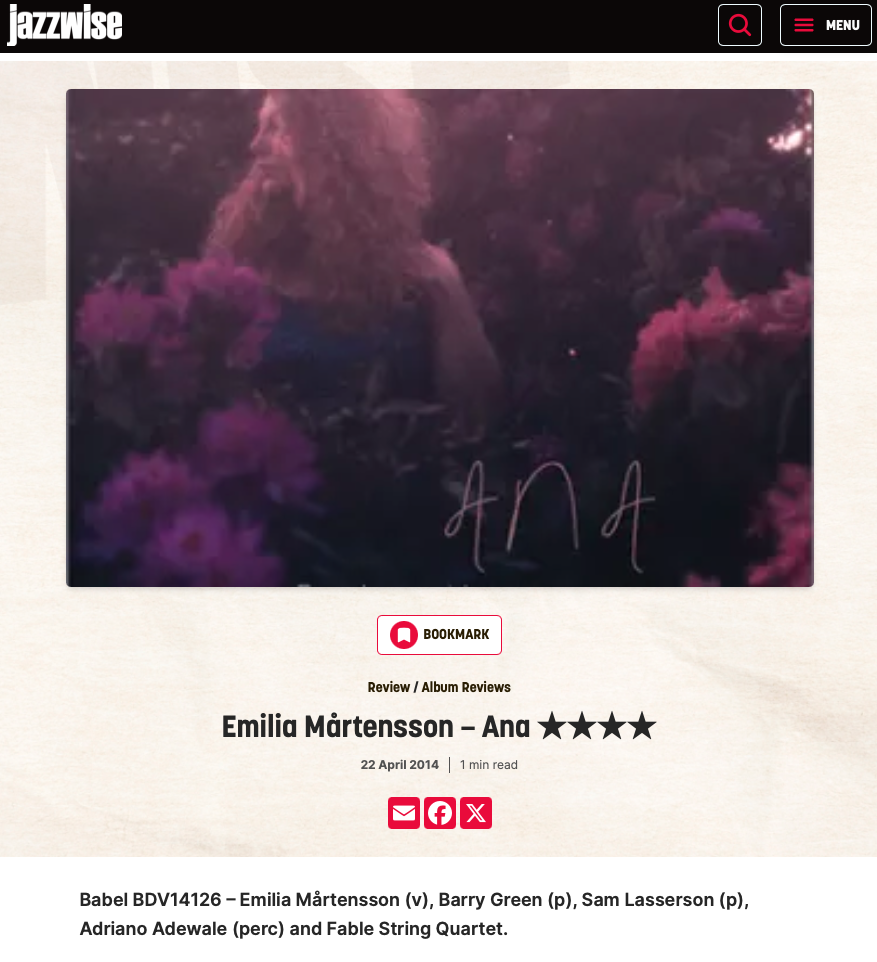
With her second album, the Londonbased Swedish vocalist Emilia Mårtensson has struck gold. Coloured by the use of strings (the excellent Fable String Quartet) and percussion, and featuring a core band that gets to the very heart of the music, the various streams of Mårtensson’s artistry – Swedish folk songs, singer-songwriters and jazz – are subtly drawn together into a profoundly satisfying whole. Named after her Slovenian grandmother, the otherworldly opening to the title track sees the singer’s voice floating ethereally over beautifully sustained string chords.
-
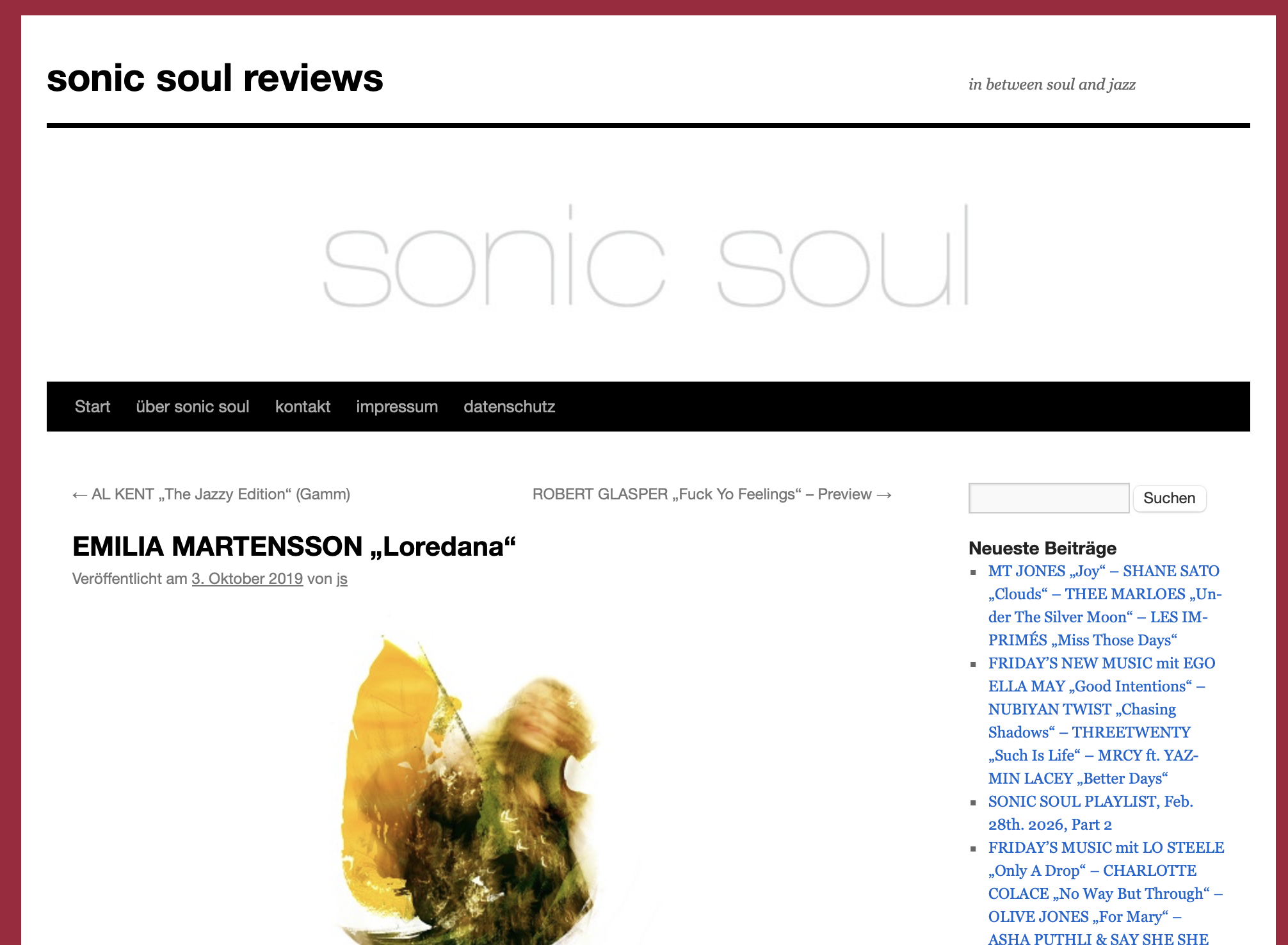
Emilia Mårtensson – Loredana
(Babel Records BDV19156. CD Review by Alison Bentley)
London-based Swedish singer Emilia Mårtensson’s jazz-folk Loredana is named after her “crazy whirlwind of a mother”. It’s a kind of sequel to her 2014 album Ana, which described her grandmother’s migration from Slovenia to Sweden.
Throughout the album, mothers feature strongly in Mårtensson’s own songs. For There (Reversed Lullaby) she asked her audience, via her website, for thoughts on their mothers: descriptions, memories, stories and regrets, to be woven into her lyric. This and three other songs are co-written with the album’s guitarist, the excellent Italian London-based Luca Boscagin. There is slow, with trip-hop backbeat, uneasy grooves and guitar laced with chorus. The intimate, close-miked vocals fade into the distance for wordless lines alongside Fulvio Sigurta’s gorgeous muted trumpet. His tone isn’t unlike his compatriot Enrico Rava. The mood is emotional, with a clear-eyed lack of sentimentality.
Loredana’s breathy vocal smooths the unsettling Lionel Loueke-ish guitar patterns; she muses on her mother’s influence: “We were kept like fallow gardens all this time, waiting for the wind to come.” There’s a sublime moment in a whirlwind rush as the instruments slide up into the drama of Adriano Adewale’s percussion. Sigurta’s keening trumpet falls into free jazz, as the hurricane builds again. (Special mention for the album’s producer Chris Hyson.) Mårtensson’s One More for Ana reflects her love of 70s singer songwriters. It’s a touching memory of her grandmother focused on domestic detail, with silvery steel-strung guitar.
Aino is based on a Finnish folk tale about a bad mother: the daughter dies to avoid a forced marriage. It’s a seam mined by Sinnikka Langeland; here the guitar resembles Langeland’s Finnish kantele behind the melancholy vocal and winding trumpet counter melodies. Mårtensson grew up singing Swedish folk songs. The traditional Jag Unnar Dig Ändå Allt Gott (“Still, I treat you well”) is given a Scandi noir treatment, with melted distant electronica in forests of reverb, the voice pure then flickering breathily.
Be Still-Grow fuses two songs, the second by Mårtensson and the first co-written with Tom Cawley: “…it’s sort of saying bye to the older generation and talking about whether there’s something new that’s going to grow,” she told one interviewer. The melodies are modal and spacious, phrases repeated over moving chords and electronic colour. It’s underpinned by bassist Sam Lasserson – his subtly rhythmic playing doesn’t draw attention to itself, but is central to the album’s sound. Two London songwriters featured on Ana are represented here: Barnaby Keen and Jamie Doe. In Keen’s Arm Ourselves (Against Ourselves) Boscagin uses folk fingerpicking with jazz chords, alongside delicate trumpet obbligato and percussion. Doe’s ballad Weariest River describes how a mother’s reassurance can fail: “I’m shocked by the future…the stories you used to tell no longer comfort me…” but “…even the weariest river winds somewhere safe to sea.” The sparse arrangement brings the voice and evocative lyrics to the fore. Doe’s Shine a Light On is a heartfelt song of protest moving from strongly rhythmic acoustic Afrobeat to loping reggae: “It’s not fair, I hope you’ll agree, that half the world should live in poverty.”
The voice has the natural sound that comes from great skill, and the songs are lovingly-crafted and played. It’s a beautiful and thought-provoking album, and one to absorb yourself in.
-
JAZZ DA GAMA- ..."It is not that the singer is sad all the time, but she is able to—because she is only part human and part music sprite that she seems not only to wrap her emotions around the music, but also to inhabit that spectral dimension; a place in the spirit world that only those with a transcendent singing ability are admitted"...
..."Emilia Mårtensson magically seems to form a musical continuum with the folk musicians of her native Sweden, while inhabiting the jazz idiom of today. This in itself is unique. There are only a handful of vocalists who belong to this species: such as Abbey Lincoln of America, Lucia Pulido of Columbia"... READ HERE
-
Jazz does indeed reside in one large house these days. Thanks to the world travels of Don Cherry and Randy Weston in the 1960s, the European free movement, The Latin voice, and the indelible mark of ECM Records, jazz has transmuted into folk music. It had to happen, what once was the province of the New Orleans bagnio and the metropolis spread to the rural peoples becoming global. Or, perhaps it was the countryside that has seeped into the city.
That intersection has fostered the Americana sounds in Bill Frisell's jazz and the Swedish folk in London- based vocalist Emilia Mårtensson's music. Is it jazz? Yes. Folk? Of course, but it is also pop and traditional song.Ana follows And So It Goes . . . (Babel, 2012), co- led with pianist Barry Green. While the alt-pop influence is evident throughout, so too is the bond between singer and pianist. Like Tommy Flanagan and Ella Fitzgerald or Ralph Sharon's accompaniment of Tony Bennett, Green's touch piano is trusted counsel here.
Skillfully arranged with artful touches by The Fable String Quartet, the music is immediately enchanting, bewitching, and approachable. The title track, written for her Slovenian grandmother is a melancholy ballad of remembrance woven with a tinge of kinfolk sound. Mårtensson is a fan of 1970s pop covering, as she did on her previous disc, Paul Simon. Here it is "Everything Put Together Falls Apart" delivered in a spoken/sung bluesy manner not unlike that of Rickie Lee Jones with Green and Brazilain percussionist Adriano Adewale flavoring the blues with authentic spices. -
JAZZWISE FEATURE NOVEMBER 2019
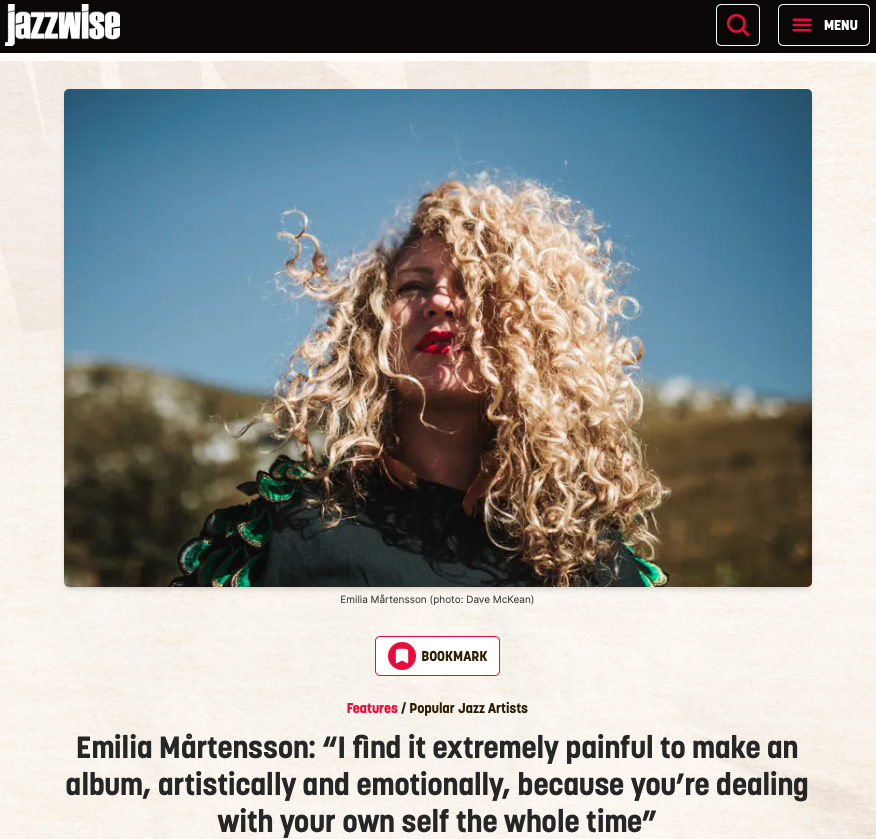
With a voice of remarkable expressive depth, Emilia Mårtensson makes music in which Swedish folk songs and jazz sensibilities are subtly drawn together into a profoundly satisfying whole. She talks to Peter Quinn about making connections, creating a narrative and finding beauty in tragedy.
When I meet her in a Soho hotel, Emilia Mårtensson needs to take a pause for breath. She’d flown in that day on a ridiculously early morning flight from a gig at Arthur’s Jazz and Blues Bar in Dublin, and was about to head off to New York later the same week – her first visit – with her Elda Trio project to perform as part of Made in the UK at Rochester Jazz Festival.
Named after and dedicated to her mother, for her new album, Loredana, Mårtensson has taken a novel approach in terms of engaging her audience to become part of the creative process. “It was about wanting to do something that everyone can relate to,” Mårtensson says. “And I find that relationship really fascinating – that you come from someone’s body and you have to have a relationship with that person.